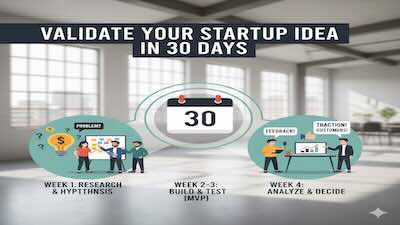
How to Validate Your Startup Idea in 30 Days
A 30-day plan for testing a startup idea on real people before you write a line of code. Covers what to test, what to ignore, and how to read the signal.
Long-form guides on the decisions early-stage founders actually get stuck on — validating an idea, splitting equity, pricing a SaaS, structuring a pitch. Plus a short, opinionated shelf of business books worth reading more than once.
Three pieces that cover the questions most first-time founders bring to us first. For an ordered path through everything, see Start here.
A 30-day plan for testing a startup idea on real people before you write a line of code. Covers what to test, what to ignore, and how to read the signal.
What pre-seed, seed, and Series A actually mean in 2026; what investors expect at each stage; and the parts of a raise nobody warns first-time founders about.
Most founders interview the wrong people and ask questions designed to get compliments. Here is how to recruit better, ask about past behavior, and pull a signal out of the conversation.
The eleven guides on the site, grouped by the decision they help you make.
For founders who have a thesis and want to test it on real people before they build.
What to prove, in what order, to which investors, with what artifacts.
The decisions that lock in the cap table and shape how the team will operate.
Shipping something small enough to learn from and big enough to be worth using.
Getting from zero users to a thousand, and pricing the thing they get.
Boring, important, and a lot cheaper to handle on day 30 than day 300.
Don’t know where to start? Try the reading path for first-time founders or skim the glossary if a term is throwing you.
If you are reading one founder book this quarter, pick from these. The full shelf goes deeper by topic.
Where the vocabulary of MVPs, build-measure-learn, and pivots comes from. The ideas have aged better than the case studies.
A contrarian argument that competition is for losers and the goal is a defensible monopoly. Disagree with it freely; the framing is still useful.
The parts of running a company nobody else writes about honestly: firing people, near-death moments, deciding under bad information.
A short, blunt manual on how to talk to potential customers without collecting compliments. The fastest read on this list and the highest hit-rate.